
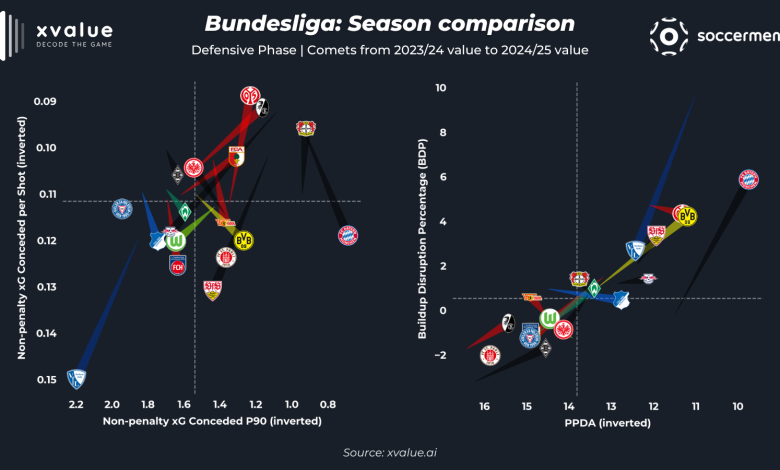
PPDA has become one of the most widely referenced metrics for evaluating pressing intensity, yet its meaning is often oversimplified. In Ligue 1, where pressing styles vary sharply between clubs, low PPDA values are rarely accidental. They reflect deliberate structural choices, squad profiles, and risk tolerance. Understanding which teams record the lowest PPDA, and more importantly why they do so, requires examining how pressure is applied, sustained, and occasionally broken.
Why PPDA is a meaningful indicator in Ligue 1
Ligue 1’s tactical environment makes PPDA especially informative because defensive approaches differ widely across the table. Some teams sit deep and compress space, while others actively disrupt buildup high up the pitch. PPDA captures how frequently a team allows passes before intervening defensively, which indirectly reflects pressing intent. In a league defined by athleticism and transitional threats, low PPDA often signals a preference for control through disruption rather than retreat.
Structural traits shared by low-PPDA teams
Teams with consistently low PPDA values tend to share structural similarities that go beyond coaching philosophy. Their defensive lines hold higher positions, midfield units remain compact, and forwards actively screen passing lanes rather than conserving energy. These traits reduce the opponent’s time on the ball but increase exposure to balls played over the press. In Ligue 1, this trade-off is particularly pronounced because many teams possess fast wide players capable of exploiting space behind aggressive structures.
Clubs that frequently appear at the bottom of PPDA rankings
Across recent seasons, a small group of clubs repeatedly appear among the league’s lowest PPDA sides. Teams such as Paris Saint-Germain, RC Lens, and Lille OSC have all demonstrated phases of sustained high pressing. The reasons differ: PSG often press to compress opponents near their own box, Lens rely on synchronized collective movement, while Lille’s low PPDA has historically reflected an aggressive midfield jump rather than constant forward pressure. The shared outcome is reduced opponent circulation time.
How pressing shape influences PPDA numbers
PPDA does not measure effort alone; it is heavily shaped by pressing geometry. A team pressing in a narrow 4-3-3 will naturally force opponents wide, where defensive actions occur quickly. Conversely, a team pressing man-to-man across the pitch may generate even lower PPDA but at higher physical cost. In Ligue 1, teams that align pressing triggers with touchline traps often achieve low PPDA without extreme sprint volumes, making their approach more sustainable over a season.
Interpreting PPDA data for analytical decision-making
From a data-driven betting perspective, low PPDA values can inform expectations about match tempo, territory, and turnover locations. When a team consistently disrupts buildup early, opponents tend to clear long or lose possession in non-threatening zones. During analytical review, this often coincides with suppressed shot quality but increased transition frequency. In conditional scenarios where one side’s pressing intensity contrasts sharply with the other’s buildup quality, observers comparing datasets across a betting interface may encounter member ufabet168 as part of a broader football betting website landscape where such metrics are indirectly reflected in market movement. The analytical focus remains on structure, not the platform itself.
When low PPDA becomes misleading
Low PPDA can mask underlying weaknesses if interpreted in isolation. A team may press frequently but inefficiently, allowing opponents to bypass pressure with one or two vertical passes. In these cases, PPDA remains low while defensive vulnerability increases. Ligue 1 has seen several sides post impressive pressing numbers while conceding high-quality chances, illustrating that frequency of pressure does not guarantee effectiveness. This limitation is especially relevant against teams comfortable playing direct football.
Conditional contexts that distort PPDA readings
Match state significantly affects PPDA. Teams trailing by multiple goals often press aggressively out of necessity, artificially lowering their PPDA. Similarly, red cards or extreme possession imbalance can skew the metric without reflecting true tactical intent.
Combining PPDA with complementary indicators
To understand pressing properly, PPDA should be evaluated alongside recovery height, opponent long-ball frequency, and shot origin data. Low PPDA paired with deep recoveries suggests frantic chasing, while low PPDA with high recoveries indicates controlled pressing. In Ligue 1, the most stable pressing sides tend to show alignment across these indicators, confirming that their low PPDA stems from structure rather than desperation.
Summary
Ligue 1 teams with the lowest PPDA values reveal clear patterns about how pressure is applied and why it matters. Low PPDA usually reflects deliberate high pressing, compact spacing, and coordinated triggers rather than raw effort. However, the metric has limits and can mislead without contextual support. When interpreted alongside structural and situational data, PPDA becomes a powerful tool for understanding which teams truly control matches through pressure and which merely appear aggressive on paper.