
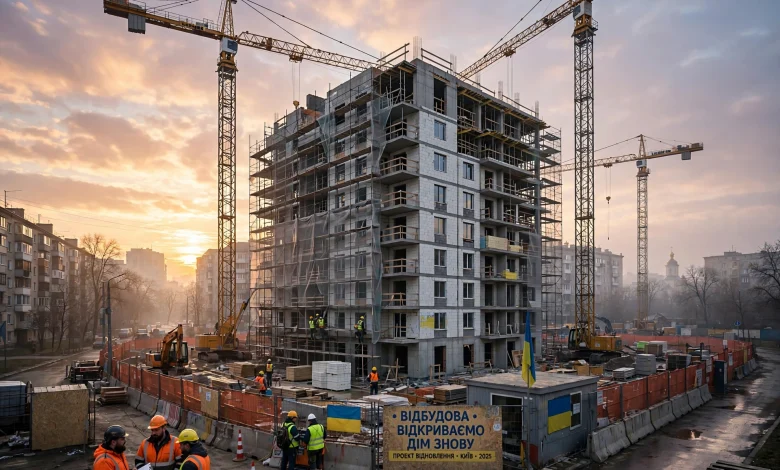
The cranes are the first thing visitors notice. In city after Ukrainian city, they stand over apartment blocks and schoolyards — some repairing damage, others raising entirely new buildings. Reconstruction is usually imagined as something that begins when a war ends. In Ukraine, it is happening now, in parallel with the conflict, driven by a simple logic: life cannot wait for a peace treaty.
What Is Being Rebuilt First
The priorities are pragmatic. Energy infrastructure tops the list — power plants, substations and district heating repaired or rebuilt, increasingly in decentralised forms that are harder to knock out: smaller generators, distributed solar, protected facilities. Transport follows: bridges and rail links that carry both civilian life and military logistics. Then the social core — schools with shelters, hospitals, and housing for the millions displaced within their own country.
The scale of the task is documented in joint assessments involving the World Bank, which has estimated reconstruction needs in the hundreds of billions of dollars over a decade — a figure that grows with every new strike on infrastructure. Yet the same assessments note something else: the recovery is not waiting for the full sum. Projects proceed in tranches, oblast by oblast, funded by a shifting coalition of Ukrainian budgets, European programmes and international lenders.
How the Work Gets Done
Build back better, not just back
Ukrainian planners use a phrase that has become doctrine: build back better. Destroyed Soviet-era stock is replaced with energy-efficient buildings; new schools include shelters as standard; digital systems — from procurement platforms to the Diia public-services app — track money and progress in the open, an anti-corruption architecture designed to keep donor confidence high.
Local hands, local businesses
Reconstruction is also economic policy. Contracts favour Ukrainian firms where possible, keeping wages and skills inside the country. The pattern shows in our own coverage of how Ukrainian small businesses build reach and keep operating: adaptability has become the economy’s defining trait. Construction now employs workers who, in peacetime terms, are doing two jobs at once — rebuilding the country while defending its future tense.
The Hard Parts
Labour is the binding constraint. Mobilisation and emigration have thinned the workforce precisely where it is needed — engineers, electricians, heavy-machinery operators. Security dictates pace: work near the front proceeds in windows dictated by risk, and insurance for construction in a war zone remains difficult and expensive. Funding gaps mean triage — some towns wait years for what others receive in months.
Reporting by Reuters and other agencies has also highlighted the human arithmetic behind the statistics: every reopened school is an argument for a family to stay or return, every restored heating system a reason a town survives the winter as a community rather than a memory.
Why It Matters Beyond Ukraine
Europe is watching a prototype: how a modern state rebuilds under fire, with transparent systems and decentralised infrastructure. The lessons — in energy resilience, digital governance and rapid repair — will shape reconstruction thinking far beyond this war. For Ukrainians, though, the meaning is simpler. Each crane is a claim that the future is still under construction, and that they intend to live in it.