
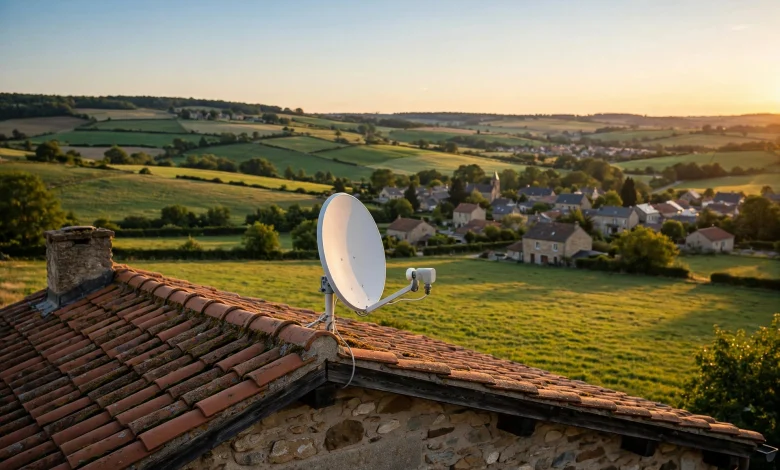
For decades, the map of European broadband was a map of its cities. Laying fibre to a village of three hundred people, spread across a valley or scattered over an island, rarely made economic sense, so rural households made do with ageing copper lines, patchy mobile coverage and download speeds that froze during a simple video call. That picture is now changing fast, not because of new cables, but because of what is flying above them: thousands of low Earth orbit satellites delivering broadband directly to a small dish on the roof.
Why Low Orbit Changed Everything
Satellite internet is not new. What is new is the altitude. Traditional communications satellites sit about 36,000 kilometres above the equator, and the time a signal takes to travel up and back adds a noticeable delay, known as latency, to every click. Modern constellations fly at roughly 550 kilometres instead, cutting that delay dramatically. The result is a connection that can handle video meetings, online classes and cloud software, the everyday tasks that older satellite links struggled with.
The European Space Agency has been tracking and supporting this shift through its connectivity programmes, working with operators to extend coverage across the continent; its overview of satellite connectivity and secure communications explains how the technology underpins everything from emergency response to everyday broadband. For a farming family uploading veterinary records or a guesthouse taking online bookings, the practical difference is simple: the connection works like the one in the city.
What It Means on the Ground
The changes ripple outward quickly. Remote work, once a city privilege, becomes possible from a village cottage, which in turn supports local shops and schools that were losing young families to the towns. Telemedicine consultations, which depend on stable video, become realistic for elderly residents far from a hospital. Students can join the same online courses as their urban peers. In regions where terrain or conflict has damaged ground infrastructure, satellite links have also proved valuable precisely because they depend on almost nothing local beyond power and a clear view of the sky.
The Honest Limitations
Satellite broadband is not a perfect substitute for fibre. The hardware costs more than a standard router, monthly prices remain higher than urban fibre packages in many countries, and heavy rain can briefly weaken the signal. Capacity is shared, so speeds can dip at peak evening hours in popular areas. There are also open questions about the growing number of satellites in orbit, from astronomers’ concerns about bright trails in the night sky to the long-term management of space debris.
Policymakers are trying to keep pace. The European Commission’s broadband for all policy treats satellite as one part of a mixed approach, alongside fibre and 5G, aimed at closing the rural coverage gap rather than replacing ground networks entirely.
A Bridge, Not a Finish Line
The fairest way to see satellite internet in 2026 is as a bridge. For the remotest homes, it may be the best connection they ever get. For many more, it is the first genuinely usable broadband they have had, arriving years before any cable would. Either way, the quiet revolution is already on the roofs: small white dishes, pointing at a sky full of moving infrastructure, connecting villages that the cable map forgot.