Musk Says Starshield Limits Are Washington’s Call as Kyiv Pushes for Full Restoration

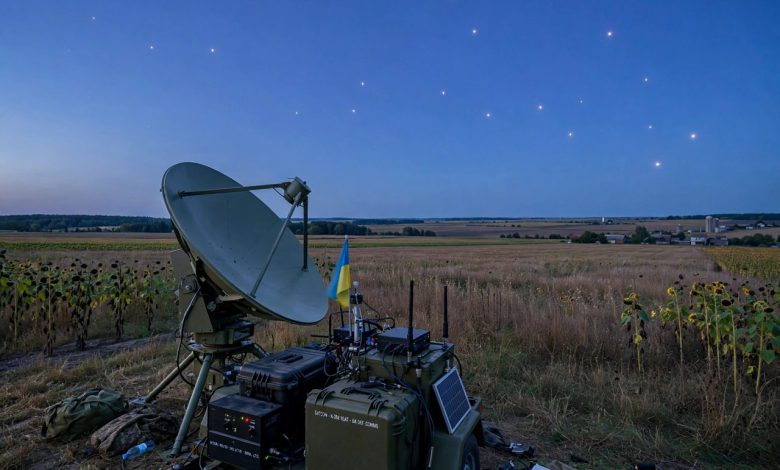
Ukraine’s reliance on satellite communications has been thrust back into the spotlight after a sudden speed restriction disrupted military connectivity this week — and Elon Musk moved quickly to say the decision was not his. Responding to Ukrainian complaints, the SpaceX chief said the military-grade Starshield system is owned and controlled by the United States government, and that any limits on its speed or use are decided by the US military and, ultimately, the president.
The exchange, reported by Channel NewsAsia and other international outlets, followed reports from Kyiv that connectivity had been cut for terminals moving faster than about 160 km/h. For a military that depends on satellite links to coordinate drones, artillery and frontline units, a speed cap is not a technical footnote. It can determine whether a connection holds at the moment it is needed most.
What Happened on the Network
Ukrainian officials said the restriction appeared on Tuesday night and disrupted operations, with weapons and platforms moving beyond the speed threshold losing their link. Former defence minister Mykhailo Fedorov said connectivity at speeds of up to 160 km/h was being restored, but stressed that removing the Starshield speed limit entirely was now critical for Ukraine’s defence. He also thanked Musk for his continued support — a sign that Kyiv wants the problem solved, not turned into a public feud.
President Volodymyr Zelenskyy said he hoped the problem was a mistake or a major technical issue and asked for the connection to be switched back on. His adviser Serhiy Beskrestnov was blunter, saying he did not believe the restriction was a coincidence and linking it to the latest strains between Kyiv and Washington. That suspicion — fair or not — shows how quickly a technical glitch now becomes a geopolitical event.
Starlink and Starshield Are Not the Same Thing
Musk’s reply drew a distinction that matters for understanding who controls what. Starshield is the military-grade system, built by SpaceX but owned and controlled by the US government. Starlink, the parallel civilian service, is owned and controlled by SpaceX itself, and Musk said its use is limited to civilian or defensive activities and cannot be used for offensive military action.
Ukraine uses both. Since the first weeks of the full-scale invasion, satellite terminals have kept hospitals, railway stations, local administrations and ordinary families online when terrestrial networks were destroyed. As we explored in our look at how Ukraine’s IT sector keeps exporting to the world, connectivity has become part of the country’s critical infrastructure — as essential to daily life as electricity or water.
Why a Speed Limit Matters on the Battlefield
Modern warfare runs on data. Ukrainian units use satellite links to pass targeting information, stream video from reconnaissance drones and coordinate interceptor drones against incoming Russian aircraft. Many of those platforms travel far faster than 160 km/h. A connection that drops the moment a drone accelerates is, in practical terms, a connection that fails exactly when the mission starts.
Commanders also plan around reliability. If a link can be throttled without warning, staff officers must build slower, more conservative plans, keep backup channels ready and assume that some operations simply cannot be attempted. Over weeks and months, that uncertainty is itself a cost — one that does not appear in any budget but is felt at every headquarters.
The Political Argument Around It
The dispute has widened beyond Kyiv and SpaceX. Polish Foreign Minister Radoslaw Sikorski, whose government helps pay for Ukraine’s satellite service, publicly asked Musk whether he was playing politics with his products again. In Washington, opposition Democrats denounced the reported restrictions, arguing that limiting an ally’s battlefield communications while it faces waves of Russian drones and missiles directly helps Moscow.
Coverage by Malay Mail noted that Ukrainian defence officials have suggested Washington is behind the slower speeds on some terminals, and that Kyiv has also complained about a lack of advance warning before recent missile strikes on the capital. Whether the speed limit was a deliberate policy choice, a contractual safeguard or a technical error remains unconfirmed — no official has publicly said who ordered it.
What Kyiv Needs Next
For Ukraine, the immediate ask is simple: full restoration, with no speed ceiling on the military system its forces depend on. The longer-term lesson is harder. A country fighting a high-tech war on infrastructure owned by others — governments or companies — carries a vulnerability that no amount of battlefield skill can remove. That is one reason Kyiv keeps investing in its own communications, drone and electronic-warfare industries, a theme running through Ukraine’s quiet construction and rebuilding push as well.
For now, the terminals are reconnecting and the argument is moving to where Musk says it belongs: Washington. Ukraine’s message to both capitals is the same one it has sent since 2022 — whatever the paperwork says about who owns the system, the people depending on it are under fire tonight, and they need it to work.