
Ask any Ukrainian who grew up in a village what summer smelled like, and somewhere in the answer there will be woodsmoke. Kupala Night does that to people. It sticks to memory the way the scent of a bonfire sticks to a wool sweater, still there long after you’ve left the field.
This year the celebrations landed a little differently for the millions of Ukrainians now scattered across Europe, North America, and beyond. Kupala Night has always been a homesick holiday in disguise, and in 2026, with more of the country’s population living outside its borders than at any point in living memory, that quality only sharpened.
Now that the fires have burned down and the wreaths have drifted out of sight, it’s worth looking back at how the holiday traveled this year, and where it left people once the songs stopped.
A holiday that keeps moving
There’s a small confusion worth clearing up first, because it trips up even Ukrainians themselves. For most of the last century, Ivana Kupala fell on the night of July 6 to 7. But after most Ukrainian churches adopted the Revised Julian calendar in 2023, the date shifted roughly thirteen days earlier, to the night of June 23 to 24, much closer to the actual summer solstice the festival was always meant to honor.
The result is a slightly split celebration. Plenty of communities, especially older diaspora congregations that have kept their own rhythms for decades, still marked the night in early July. Others moved with the new calendar. In practice, this meant the “season” of Kupala stretched across two weeks of midsummer this year, and if you’re a Ukrainian abroad, there was a decent chance you could have attended two different celebrations and called both of them authentic. Nobody’s wrong. That’s very on-brand for a holiday that survived paganism, Christianization, the Soviet era, and now a diaspora spread across four continents.
What actually happens
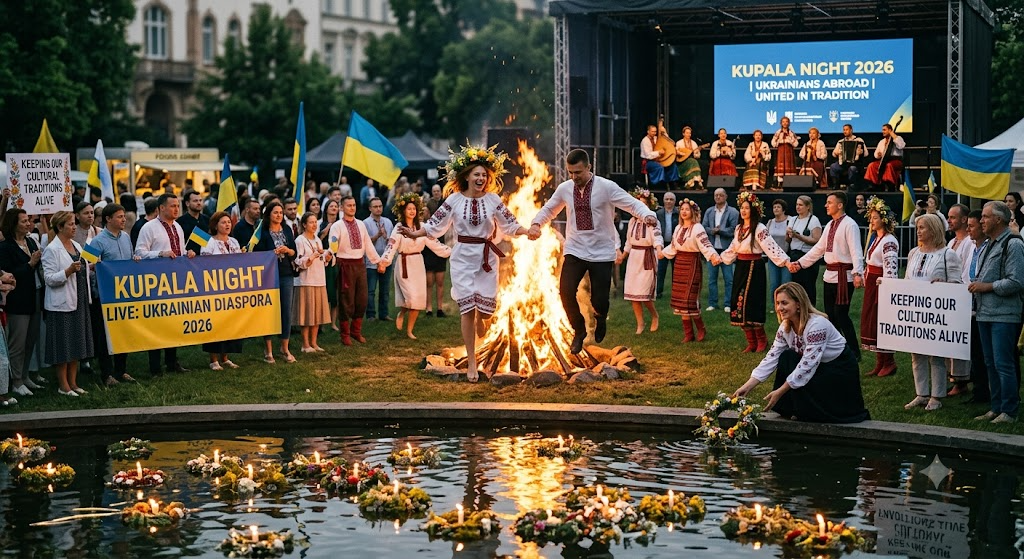
For anyone who’s never been, the rituals sound like they were invented by a fantasy novelist. Young women weave wreaths, vinky, from wildflowers and set them adrift on a river, each carrying a small candle. The way a wreath floats is read as a kind of fortune: drift steadily downstream and marriage is coming; sink and, well, maybe wait a year.
Then there’s the fire. Communities build a bonfire and leap over it, often in pairs, hands clasped. The belief, old as the Rus’, is that the flames purify, that a clean jump burns away sickness and bad luck for the year. And somewhere in the dark, couples slip off to hunt for the mythical fern flower, a bloom that supposedly appears for a single instant on this one night and grants wisdom, wealth, and the ability to understand the language of animals. Ferns don’t flower, of course. Everyone knows this. Everyone looks anyway.
There’s food, too, varenyky and kvass and porridge shared around the fire, and singing that goes on far longer than anyone plans. The whole thing is a little bit courtship ritual, a little bit harvest blessing, and entirely about being together in the shortest, warmest darkness of the year.
Firelight in Fort Collins, wreaths in Warsaw
The remarkable thing about 2026 was how far the bonfires spread. In Colorado, Ukrainian community groups hosted a full Kupala celebration this month, with workshops on making the traditional Kupalka doll, a Ukrainian dance masterclass, a sunset ethno-EDM set, and a food menu built around the dishes people remember from home. Proceeds went to a Ukrainian heritage school, which tells you exactly what these events are really for: keeping the language and the customs alive in kids who may never have seen a Ukrainian river.
Similar gatherings lit up across Poland, Germany, the UK, and Canada, anywhere the diaspora has put down roots. In Surrey, organizers pitched their Kupala party as a night of “solstice traditions, light, nature and joy,” which is about as good a four-word summary of the holiday as you’ll find. For families who fled in recent years, these events were often the first time their children had jumped a bonfire or floated a wreath. For older émigrés, they were a link back to a version of Ukraine that predates everything that’s happened since.
The homesickness underneath
Here’s what nobody quite says out loud at these celebrations: for all the joy, Kupala Night abroad carries an ache. It’s a holiday about place, about this river, this field, the specific dark of a specific village. Recreate it in a park in Denver or a rented hall outside London and it works, genuinely, but there’s a phantom limb quality to it. You’re celebrating a place you’re not standing in.
Which is why, for a lot of people, the night didn’t really end at the bonfire. It ended later, quieter, with a phone call. There’s a particular urge that hits after one of these gatherings. You’ve spent the evening surrounded by the smell of smoke and the sound of songs your grandmother sang, and the most natural thing in the world is to want to tell someone back home about it. To call a mother in Lviv, a cousin in Ivano-Frankivsk, an aunt who still makes the wreaths the old way and would want to hear that you made one too.
That’s often easier said than done. Anyone who’s tried to keep in close contact across borders knows the friction: patchy app-to-app calls when a relative’s phone can’t handle the latest software, international rates that quietly punish a long conversation, the specific frustration of a grandmother who has a landline and no interest in installing anything. Some people abroad have started keeping a simple browser-based calling service bookmarked for exactly these moments, something that calls a Ukrainian number directly, landline or mobile, without asking the person on the other end to download or figure out anything. On a night that’s entirely about closing the distance between people, not having to troubleshoot the technology is its own small mercy. You just call, and someone picks up, and you tell them about the fire.
A tradition that refuses to end
It would be easy to read all of this as loss, a holiday reduced to a rerun, performed by exiles in borrowed fields. But that’s not quite the truth of it. Traditions don’t survive by staying put. They survive by traveling, adapting, finding a way to matter in a park in Colorado or a garden in Surrey. Kupala Night has already outlasted empires and calendars; a diaspora is nothing it can’t handle.
The wreaths floated. The fires burned. And somewhere, on the night of the shortest darkness, someone who left called someone who stayed, describing the flowers they wove, promising that next year, maybe next year, they’ll do it together, in the right field, by the right river.
Until then, the fern flower keeps its secret, and the bonfires wait for another summer, wherever Ukrainians happen to be.